- Home
- Products ▾
- Packages ▾
- Arc Flash ▾
- Pipe Labeling ▾
- Articles ▾
- Free Guides


Call 877-762-9280 now, create custom pipe labels for less!

Hazardous materials flow through miles of pipes in most industrial, commercial and institutional facilities. Just like hazardous materials in other environments, piping systems need to be properly labeled to make people aware of the hazardous materials they carry. The ANSI/ASME A13.1 program for identification of piping systems addresses this need by offering a common pipe labeling methodology for use in any facility.
The new A13.1 standard is recommended for all new installations. For facilities with existing labeled pipe installations, it is recommended that you update your old pipe labels for uniform identification. Where updating is not possible, older standards may be continued. Industrial Safety Solutions supports all versions of the A13.1 standards, and with a full lineup of pipe labeling supplies.
ANSI / ASME A13.1 standards define the proper colors schemes for pipe labeling. The A13.1-1996 standards have recently been replaced by the updated A13.1-2007 standard, though both are still widely used. Both color schemes are referenced below - depending on your company policy, compliance update schedules and existing labeling, you may choose to use either standard.
| ANSI / ASME A13.1-1996 Standard | ||
| Classification | Sub-Classification | Label Color |
|---|---|---|
| Materials Inherently Hazardous |
|
BLACK ON YELLOW |
| Materials of Inherently Low Hazard | Liquid or Liquid Admixture | WHITE ON GREEN |
| Gas or Gaseous Admixture | WHITE ON BLUE | |
| Fire Quenching Materials | Water, Foam, CO2, Halon, etc. | WHITE ON RED |
| ANSI / ASME A13.1-2007 Standard | |
| Fluid Service | Color Scheme |
|---|---|
| Fire Quenching Fluids | WHITE ON RED |
| Toxic and Corrosive Fluids | BLACK ON ORANGE |
| Flammable Fluids | BLACK ON YELLOW |
| Combustible Fluids | WHITE ON BROWN |
| Potable, Cooling, Boiler Feed and other water | WHITE ON GREEN |
| Compressed Air | WHITE ON BLUE |
For optimal workplace safety, every above-ground pipe should be labeled. Highly visible or frequently accessed pipes may be the most important to label for day-to-day safety, but difficult to locate or infrequently accessed pipes should be labeled as well. Labeling pipes according to ANSI A13 helps guarantee a safe work environment.
Pipe marking labels must effectively communicate the contents of the pipes and give additional detail if special hazards (such as extreme temperatures or pressures) exist. The legend should be short in length and easy to understand. For example, the legend "Steam 100 PSIG" specifies the contents as well as the additional pressure hazard. An arrow should be used in conjunction with the legend to show which direction the material flows.
The letters on pipe labels should be a minimum of 1/2" high, and should increase in size as the pipe diameter increases. The following table indicates ANSI-recommended letter height for various pipe sizes.
| Outside Pipe Diameter (OD) | Letter Height |
|
.75" to 1.25" |
.5" |
|
1.5" to 2" |
.75" |
|
2.5" to 6" |
1.25" |
|
8" to 10" |
2.5" |
|
over 10" |
3.5" |
The main thing to remember is that labels should be positioned on the pipes so they can be easily read. Proper label placement is on the lower side of the pipe if the employee has to look up to the pipe, on the upper side of the pipe if the employee has to look down towards the pipe, or directly facing the employee if on the same level as the pipe. Labels should be located near valves, branches, where a change in direction occurs, on entry/re-entry points through walls or floors, and on straight segments with spacing between labels that allows for easy identification.
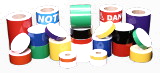
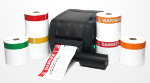
Industrial Safety Solutions offers durable vinyl labeling tape in all the required sizes and colors for ANSI pipe marking. Our pipe labeling printer packages ship complete with software to help you quickly and easily create custom pipe marking labels. We also provide free full-color pipe marking guides.




Industrial Safety Solutions (ISS) provides supplies which exceed the quality specifications outlined by
the original equipment manufacturer. ISS is the manufacturer of SafetyPro vinyl labeling tape. We offer
money saving options for DuraLabel owners. Contact us with questions about DuraLabel compatibility.
MiniMark, GlobalMark and PowerMark are registered trademarks of Brady corporation. DuraLabel is a
registered trademark of Graphic Products. LabelTac is a registered trademark of Creative Safety Supply LLC.
All trademarks and registered trademarks are the property of their respective owners.
* The term DuraLabel Vinyl denotes DuraLabel compatibility. Similar terms for DuraLabel, Brady, or LabelTac printers or
supplies may be used to denote potential compatibility or for general reference.